


Today, we’re announcing the first details of Sundae v4, the next iteration of the SundaeSwap protocol.
For the last five years, Sundae Labs has focused on building protocols that meet the moment of Cardano’s journey.
Sundae v1 brought core trading primitives to a Cardano with fresh smart contract capabilities.
Sundae v2 refined the core user experience that a Cardano DEX could provide.
Sundae v3 leveraged new features and technologies to deliver huge performance gains to the Cardano trading landscape, scaling throughput by a factor of 10.
Cardano has spent the last decade getting the technological foundations right. Despite that, it’s watched the DeFi meta consistently outpace it. Now the network is on the verge of many exciting new protocol upgrades and product launches that represent a leap forward for the DeFi landscape. We’ve designed Sundae v4 to meet this moment, structuring it carefully around a theme of Professional DeFi. Each feature answers: What does Cardano need for DeFi to be efficient, innovative, and competitive in the broader market?
Sundae v4 is built around a modular pool architecture. A pool is simply a reserve of tokens and an issued pro-rata claim on that reserve (an LP token). Everything else about the pool is configurable. Like LEGO bricks, professional liquidity providers and other DeFi protocols can plug together features to create a pool that serves the asset they’re trying to deploy or the customer they’re trying to reach: they can reuse the scooper authorization module to prevent front-running, while swapping out a custom liquidity curve. Or they can deploy pools that add additional restrictions required by their risk and regulation departments.
This may seem trivial. Why couldn’t they just build the primitives they need themselves if they wanted, forking the open source Sundae contracts? The key insight is that the Sundae ecosystem will automatically integrate these primitives. They’ll appear in the SundaeSwap UI, receive SundaeSwap order flow, benefit from SundaeSwap’s integrations with aggregators, and more.
These professionals don’t want to bootstrap their own entire protocol from scratch, they just want to customize the pieces that matter to them.
Let’s give you eight examples of how Sundae v4 supports this mission. Be aware that not all of these features will be available from day one, as we’re planning for a rolling deployment.
Automated Routing

In most Cardano DeFi protocols, the route for an order is explicit; the user specifies the pool that they wish to execute against, the token they wish to receive, and the minimum amount they must receive.
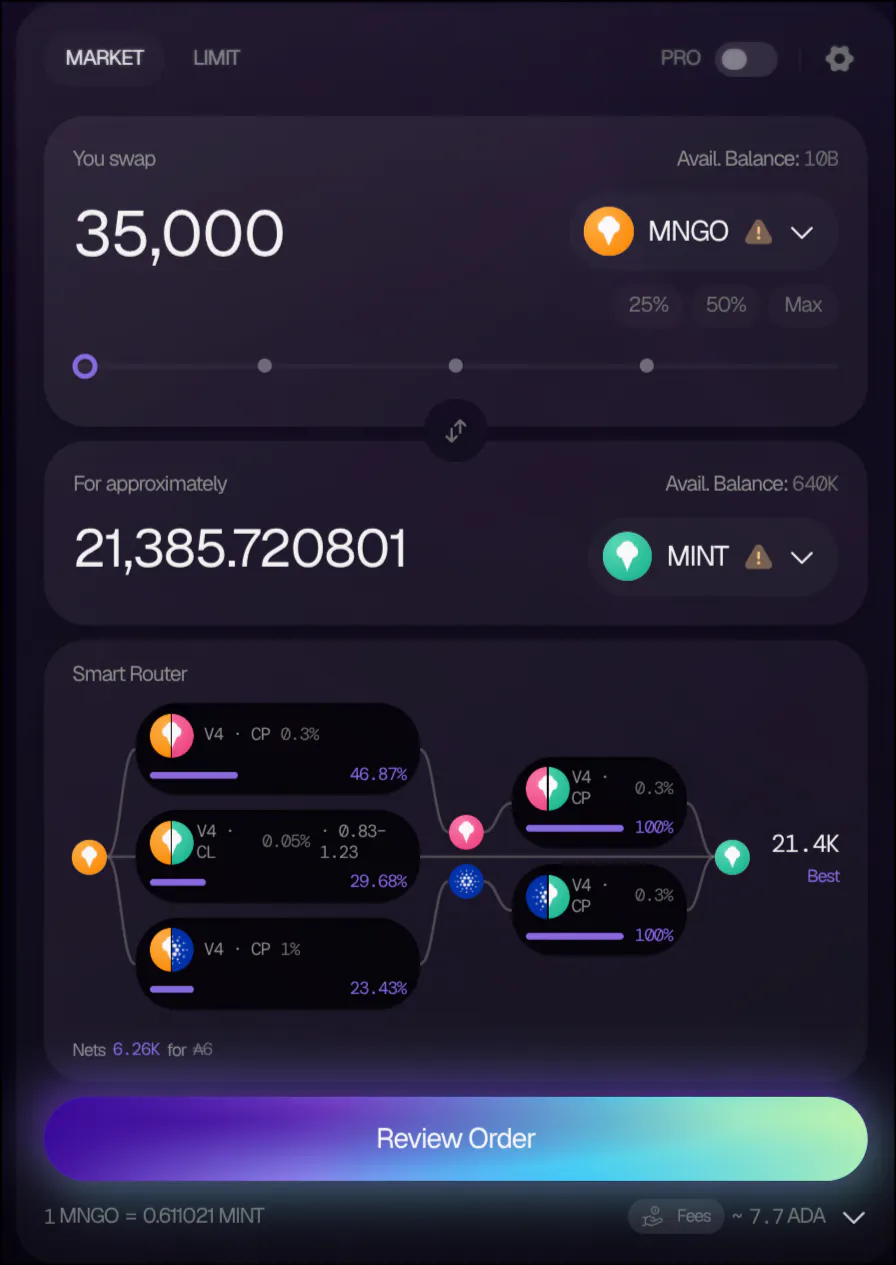
Users have taken to using DEX aggregators to find the best price, optimizing an order by splitting it across multiple pools and DEXs to maximize the output of a trade.
In Sundae v4, we made this an explicit part of the order. A user can still be explicit about the route, if it’s important. But by default, the user leaves it to the scooper executing their order to optimally split it across many pools. Sundae v4 will operate internally like a DEX aggregator, splitting orders across arbitrary pools and routes to maximize the resulting asset for the user. The smart contracts enforce that any surplus generated this way is directed to the user, rather than leaking to the scooper.
Composition between Protocols
Sundae v4 is built to be naturally more composable with other DeFi protocols.
When fulfilling user orders, other protocols can be integrated to make those trades more capital efficient. When swapping from ADA to Butane’s synthetic gold token, MIDAS, if it is more efficient to use the ADA to mint ADAb and swap for MIDAS, the protocol can do this atomically. When swapping between stablecoins, the Sundae protocol can route through Indigo’s peg stability module. In a distressed market, it will help execute liquidations to unlock liquidity for more efficient trades. It can pull trades from our own orderbook, but also universal orderbooks like the DeFi Kernel.
Each of these drives more efficient trades for the user, attracting more order flow throughout the ecosystem, and driving higher yields for liquidity providers. This is the direct payoff of the flexibility built into the automated routing.
If you are building a protocol and you can see a way that it can collaborate with the Sundae protocol, reach out, we’re happy to help you design and implement the integrations you come up with!
Custom Vaults
The entire DeFi narrative outside of Cardano for the last year has been centered around managed vaults. Projects like Morpho and Gauntlet allow users to deposit funds, and then a curator can deploy them into other DeFi protocols to capture yield.
We recognized this trend early, and attempted to provide those tools with Sundae v3, via “Strategies.” Unfortunately, strategies saw little adoption. With shallow liquidity and low volume, there was little benefit to other protocols in utilizing these features, and everyone was focused on their own survival.
However, with incoming initiatives like the DeFi Liquidity budget and the AlphaGrowth yield growth project, we believe the moment is ripe for these primitives. Strategies will remain one of the tools that builders have available in Sundae v4, but liquidity pools have also undergone a flexibility upgrade.
As mentioned before, in Sundae v4, a pool is simply a pro-rata claim on deposited reserves, and everything else, from the ability to trade, the pricing curve, and any more advanced operations, is configurable and extensible.
This means that projects like AlphaGrowth can (on their own or in conjunction with Sundae Labs) build custom vaults that they feel will attract yield. This could range from a vault that deploys a portion of capital into other protocols while enabling trading on the underlying virtual reserves (known as “rehypothecation”), to advanced concentrated liquidity pools that auto-rebalance based on an external oracle.
Because of the flexibility of the order routing, these custom pools immediately participate in active trades. They don’t need to go out and find order flow for a new instrument. A user trading ADA to NIGHT will now route through a custom concentrated liquidity pool without the user ever knowing it was there.
Multi-asset Pools
The modular and customizable nature of Sundae v4 has made it easy to support multi-asset pools.
Normally, in Cardano DeFi, every pool is only a pair of assets. ADA + SUNDAE, or USDM + USDCx.
But this poses a challenge for liquidity providers: a given pair on its own may have insufficient organic volume to support it and offset the impermanent loss.
With Sundae v4, users can create a pool with a bundle of assets, such as ADA, SUNDAE, INDY, and WRT. Collectively, their volume has a higher chance of offsetting the impermanent loss than each pair alone would, and allows the assets to pull double or triple duty, rather than being split across N different pools.
Of course, this also creates exposure to all assets in the pool, so a liquidity provider should always evaluate the risks associated with their deposits.

Concentrated Liquidity

A major innovation of Uniswap v3 was the notion of “concentrated” liquidity.
In a normal constant product AMM, the liquidity you deposit is spread evenly across all price points. That means higher slippage for traders, resulting in less volume and thus less revenue for liquidity providers. Uniswap v3 pioneered a model that enabled liquidity providers to “concentrate” their liquidity around a price where they believe most trade volume will happen, reducing slippage and amplifying their earned fees (within that range). Conversely, while the market is trading outside of a given range, that position earns no fees, allowing those who allocated liquidity correctly to collect them instead.
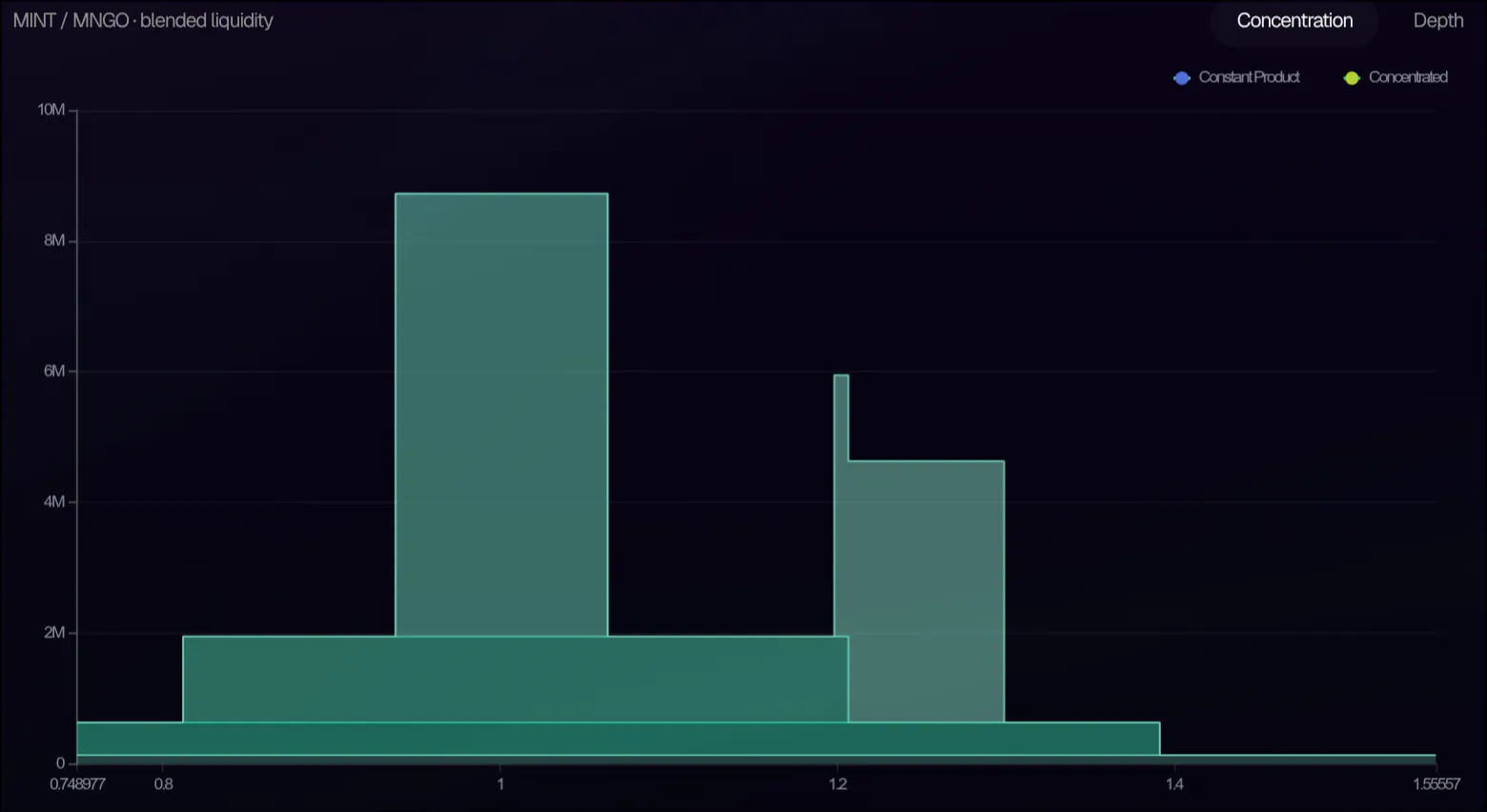
Sundae v4 adds a UTxO-native version of concentrated liquidity. Splitting liquidity across many different pools, each with their own price range, allows depositors to efficiently express their belief about the market. Combined with the automated routing described above, this allows user trades to benefit from the most efficient blended price across all ranges.
Cardano’s UTxO programming model allows these concentrated liquidity pools to maintain a small, isolated state (rather than the large granular tick data structure in Uniswap’s pools), while still automatically routing user orders efficiently across the allocated liquidity.
The end result is an ecosystem where thin liquidity is allocated right where the market believes it’s needed. Traders experience lower slippage, can trade in higher volume, and as a result, shrewd liquidity providers earn much higher fees when they bet correctly.
Linear Swaps

In a liquidity-constrained environment, it hurts Cardano to have multiple stablecoins. They fight over deposits, diluting the capital efficiency of any pairs they participate in. But having a diversity of stablecoins, with different risk profiles, jurisdictions, and use cases, makes the ecosystem more resilient and reaches users that no single token can.
Stableswaps partly solve this; they create a market where stablecoins can trade much closer to a 1:1 ratio, experiencing minimal slippage.
But from a UX perspective, this is still challenging. It’s difficult to integrate a stableswap into payment flows and other products, so it doesn’t truly abstract away which stablecoin a business can support. They have to carefully account for what happens if the order fills for slightly more or slightly less.
So we built and designed Linear Swaps. A simple idea on the surface, they allow liquidity providers to deploy baskets of stablecoins they trust, which trade at a perfect 1:1 ratio (plus a predictable fee). No impermanent loss, no slippage, perfect capital efficiency. Because the trade is purely deterministic, it can be integrated naturally into other products without worrying about slippage complicating the downstream payment flows. These stablecoins become truly interchangeable.
The natural downside of this approach is that imbalanced demand may cause one token to run out. Without arbitrage, there is no natural pressure to replenish a diminishing asset, and the pool may be unable to serve order flow, shedding it to other more standard pools. To solve this, the pool incorporates a bounty system, allowing the liquidity providers to incentivize users who loop the stablecoins through the classic financial system, restoring the balance of the pool between them. By making this explicit, rather than relying on arbitrage, the whole product is far more predictable and efficient.
Partial Fills

Limit orders have always operated a bit oddly with constant product pool DEXes. A limit order intends to fire at a specific price: buy ADA when it drops below $0.15, for example.
However, when the price on the pool reads “$0.15”, because of slippage, only the smallest orders can actually realize that price.
Thus, the price of the pool must drop sufficiently far so that, even after slippage, your order nets you the target price. This has often confused users, and resulted in missed fills. Sophisticated users would work around this by placing many smaller orders, which could execute as the price grazed their target.
With Sundae v4, order contracts can now be partially executed. You can set a budget, and that budget determines how aggressive the scooper will be in splitting your order into many small executions. For a small amount of extra ADA in fees, you can now place larger limit orders and they will work much closer to how you would expect on a centralized exchange. In the same way that automated routing splits your order across many pools, partial fills allow your order to be split across time.
Forward Ready
Finally, Sundae v4 has been carefully designed to be both upgradable and ready for future protocol improvements. We’ve validated Sundae v4 on Midgard and Leios. We’ve carefully designed the pool module to be modular enough to quickly take advantage of future improvements like nested transactions, account address enhancements, and programmable tokens.
And, of course, both Sundae v4 and Gummiworm have been co-designed to provide unique cross-layer benefits. Liquidity in certain Sundae v4 pools will be able to satisfy trades that happen inside Gummiworm L2 ledgers, and vice versa.
Asking users to migrate liquidity between major versions is an extreme step, and we wanted to be sure Sundae v4 would stay relevant and support the needs of the ecosystem for as long as possible.
Conclusion
We’ve held off discussing Sundae v4 until it’s nearly ready, as we wanted to catch you mostly by surprise. Sundae v4 is code complete, and nearly finished with its audit. It will begin launching within the next month. We’ll start with a small, core set of features, and then release new features at a regular cadence as we gain confidence.
There’s much more we have to share: what it means for existing v3 liquidity, a concrete timeline, the results of the audit, benchmarks, and deep dives into each feature. Today was the free flavor sample before the full double-scoop ice cream cone, so follow our socials and stay tuned for more soon!