Bring your own rules
The consensus protocol does not change when the ledger does. Write the state machine your application needs instead of expressing it as a circuit or bending it around someone else's virtual machine.
Sugar Rush is live on a Gummiworm head
A custody settlement protocol. A small head sequences transactions as fast as it can sign them. A larger coil holds the keys. Neither one can move user funds alone.
Gummiworm
single headSoft confirm
~370μs
Sequences and evaluates the request, then applies it to the ledger.
Small peer set · one round of signatures
Hard confirm
Coil quorum
Checks the head's work and co-signs the L1 effects it produced.
Large peer set · M-of-N quorum
Settled
L1 finality
Deposits absorb, withdrawals remit, and the effect is irreversible.
Script demands head unanimity and coil quorum
Speed comes from a small consensus group. Safety comes from a large one. Running them as separate jobs means you stop trading one against the other.
Head peers sequence and evaluate. They never hold a key that releases the treasury. The L1 script wants a signature from every head peer and a coil quorum before anything leaves, and every disbursement traces back through the request log to a deposit.
Compromising a head peer buys an attacker sequencing, not custody. Operators carry no key-loss risk, which is what makes a peer set small enough to be fast also safe enough to run.
The head produces a block as soon as it collects one round of signatures. Nothing waits on the coil, and the coil never has to be fast, because the consensus is deterministic: the same request order yields the same L1 effects.
If consensus stalls, post-dated fallback transactions hand control to a rules-based regime. Users prove their share against the last hard-confirmed evacuation commitment and withdraw without asking anyone. No operator to find, no race for block space.
Gummiworm treats the L2 ledger as a black box. It passes commands in, reads validity and state changes back, and never inspects what happened in between.
The consensus protocol does not change when the ledger does. Write the state machine your application needs instead of expressing it as a circuit or bending it around someone else's virtual machine.
Custody splits by the conditions it is held under: deposits, exits, operating equity, fallback. Switch a compartment off, or add one, to match how your application actually takes money in.
A head keeps a separate evacuation map per chain and signs for each of them, so assets can cross atomically inside one market. Cardano is implemented. Ethereum and Midnight are specified.
Opening a head costs 0.19 ADA. A deposit costs 0.18, and so does each major version that absorbs deposits or remits payments, whatever the head ran in between.
April 2026. Single peer, JSON transport, informal production-class hardware.
370μs
Soft confirm
Order in, ledger apply, persist, over network latency.
4,000TPS
Peak throughput
Sustained average of 3,400 TPS on the same head.
70,000TPS
Ledger alone
Sugar Rush matching and state transitions, transport removed.
0.18₳
Per deposit
0.19 ADA to open the head it lands in.
The gap between 4,000 and 70,000 is transport, not the book. Verbose JSON serialization is the current bottleneck; binary framing, request batching, and pipelining are projected to clear 20,000 TPS.
The trade is a signature quorum where others put a proof, in exchange for finality in one round and a ledger you write yourself.
| Approach | How it settles | What Gummiworm gains | What it gives up |
|---|---|---|---|
| Optimistic rollups | Fraud proofs inside a challenge window. | Finality in one round of signatures instead of a week-long window. | A rollup needs one honest observer. Gummiworm needs an honest head peer or a coil quorum. |
| ZK rollups | A validity proof on every state transition. | The ledger is a black box, so there is no circuit to write and no prover to pay for. | A validity proof is a stronger guarantee than a signature quorum. |
| State channels | Unanimous signatures across a fixed, small set. | The signing set scales far past a channel, and deposits and withdrawals happen while the head is open. | Unanimity between two parties trusts fewer people than a coil quorum does. |
| Multisig bridges | A threshold multisig holds the funds. | If consensus stops, users prove their share and withdraw. Funds do not sit locked waiting on an operator. | Both put custody behind a threshold signing set. Gummiworm adds a way out, it does not remove the threshold. |
Sugar Rush is a central limit order book running as an L2 ledger on Gummiworm. Orders are encrypted on the client and stay unreadable to the server until they match. The head sequences every one of them.
Sugar Rush
First ledger on a head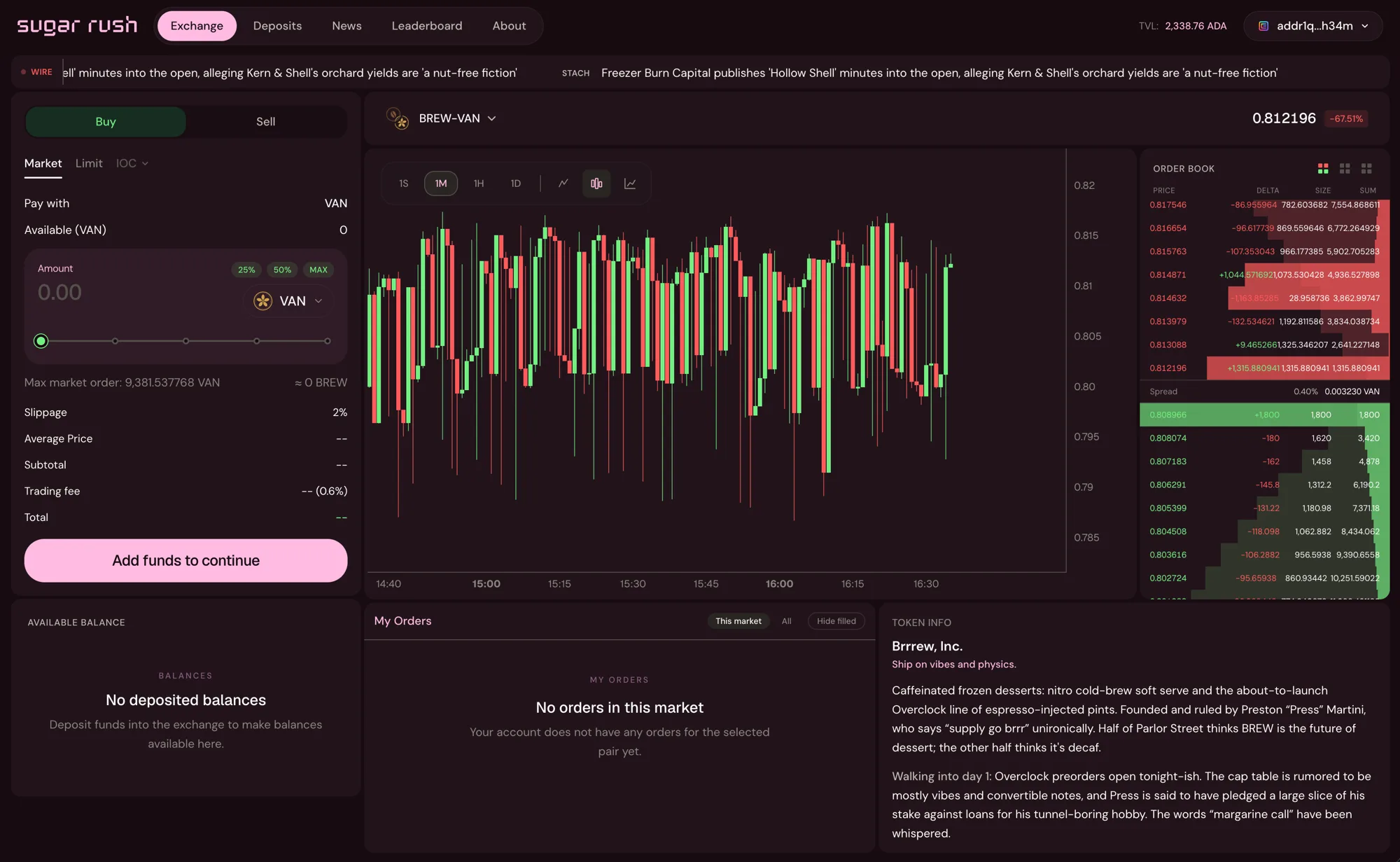
The single-head protocol is specified, deployed, and running a real ledger. These are the parts that are not finished.
Running
Next
Sugar Rush is the first one running on a Gummiworm head. Talk to the team about the second.